
September 1, 2026 · by Orijin
Traceable Coffee Means Nothing If the Farmer Never Sees the Money
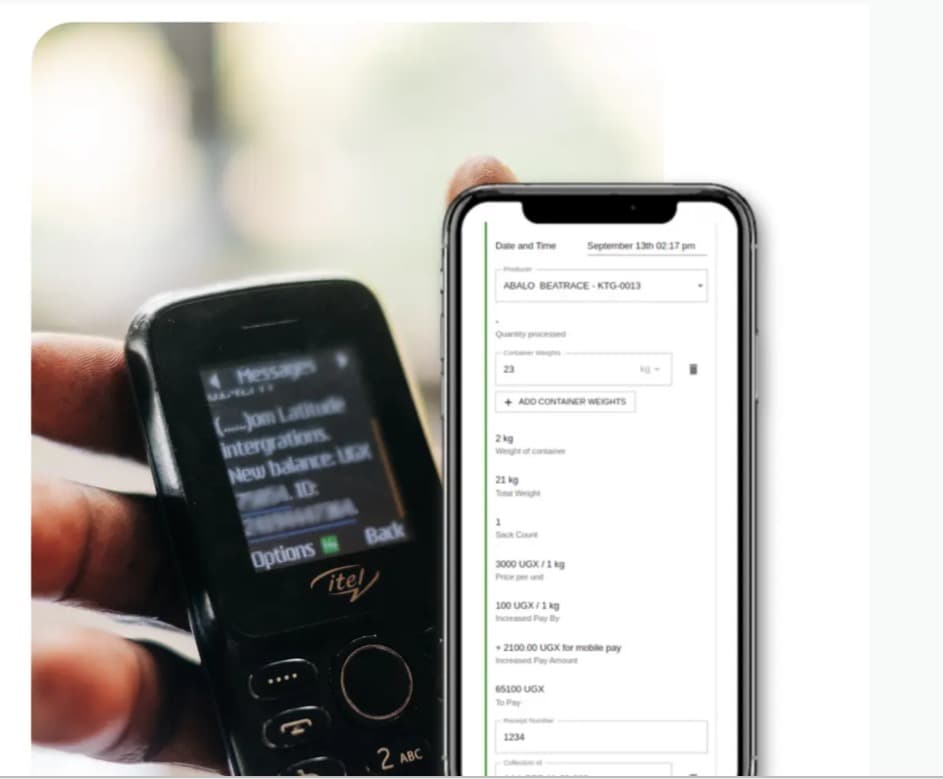
Over the past few years, the conversation around ethical sourcing has been dominated by deforestation risk, plot mapping, and compliance checklists. All of that matters. But there is a piece of the story that gets far less attention than it deserves: what actually happens at the moment of payment.
The Cash Problem Nobody Wants to Own
Nearly three-quarters of agricultural payments are still made in cash. For an industry that talks constantly about traceability, that number should be uncomfortable.
Cash creates three problems at once:
- Vulnerability. There is no institution standing behind a wad of notes in a farmer's pocket. Loss and theft are always a risk.
- Access. Cash requires physical proximity to collect and spend—often after a long walk or a long wait.
- No traceability. Even the most rigorous plot mapping and compliance documentation stops short at the one step that matters most to the farmer.
Most origin teams can map every plot on a farm and pass every compliance check an auditor throws at them—and still pay the person who grew the crop in a way that leaves no record at all.
Ethical sourcing isn't only about forests. It's about whether the person who did the work got paid fairly, quickly, and on record.
Cash-based buying creates leakage, disputes, and audit trails that nobody, buyer or farmer, can fully trust.
Why We Built Mobile Money Into Orijin
Mobile money is one of the core features inside the Orijin platform. It was built specifically to close the gap between compliance on paper and fairness on the ground.
Pay at collection
Suppliers can be paid via mobile money right at the point of collection. There's no delay between delivery and payment, and no separate trip required to settle up later.
Works with local providers
Orijin integrates with whichever mobile money provider your farmers already use. Buyers are not locked into a single payment system—the platform works with the infrastructure that already exists in a given region, rather than asking farmers to adopt something new.
Enrollment and name matching upfront
Wallet enrollment and name matching happen before the first payout. Payments go to the right person the first time, reducing the errors and disputes that come with manual reconciliation.
Every payment tied to the lot
Every payment is tracked against the lot in the dashboard. Finance teams get a clear, auditable record instead of a paper trail that can be lost, altered, or simply never created in the first place.
Making Sure the Money Reaches the Right Person
Most mobile money users never think about what happens behind the scenes. You send money to a phone number, and you trust it lands where it should.
But when a buyer is paying out to hundreds or thousands of farmers at once, that trust has to be built into the system—not assumed.
Before any payment goes out through Orijin, we verify that the phone number on record actually belongs to the person being paid, matching the registered name against the mobile money line. It happens once, upfront, quietly.
The result: a mistyped digit, a shared phone, or a name mismatch gets caught before a payment goes out—not after a farmer calls asking where their money went.
What This Looks Like in Practice
In practice, this changes the buying process in a very concrete way:
- Buyers record the purchase and trigger the payment in the same flow—no separate payment process to manage on the side.
- Suppliers get paid digitally at the point of collection, instead of waiting for cash to physically arrive.
- Finance teams end up with a record that actually holds up during an audit, tied directly to the lot it belongs to.
For exporters and aggregators operating under increasing buyer and regulatory scrutiny, that record is no longer a nice-to-have. It is quickly becoming table stakes.
The Impact Goes Beyond the Transaction
The value of digital payment doesn't stop at the moment money changes hands.
Digital payments are a gateway to other financial products—credit, savings, and insurance—the kind of tools that help farmers build resilience against climate risk and market volatility. A farmer who receives payment into a mobile money wallet has a financial footprint. That footprint can open doors that cash never could.
Financial inclusion at the farm gate
This matters even more when you look closely at who is actually doing the work. In many smallholder farming communities, women carry a large share of the labor in coffee and cocoa production, yet are significantly less likely to have a bank account or a mobile money wallet registered in their own name.
When payment is made in cash to whoever happens to be present—or to a male relative by default—that gap only widens.
Paying directly and traceably into the right hands isn't a minor implementation detail. It can be the difference between a farmer having access to her own income or not.
Why Now
Buyers are already asking about living income, payment transparency, and financial inclusion—not just deforestation risk.
As mobile money adoption continues to grow across Africa and parts of Latin America, digital payout is no longer a pilot project. It is practical, proven, and ready to work at scale today.
Traceability without fair, traceable payment is only half the story. Connecting collection data to mobile money payouts is how origin companies close the loop between compliance and the livelihoods of the people whose work makes that compliance possible.
See It in Action
Want to see how mobile money payments could work for your supply chain?
- Visit orijin.io
- Email us at hello@orijin.io
What would it take for your farmers to get paid the same day they deliver?